
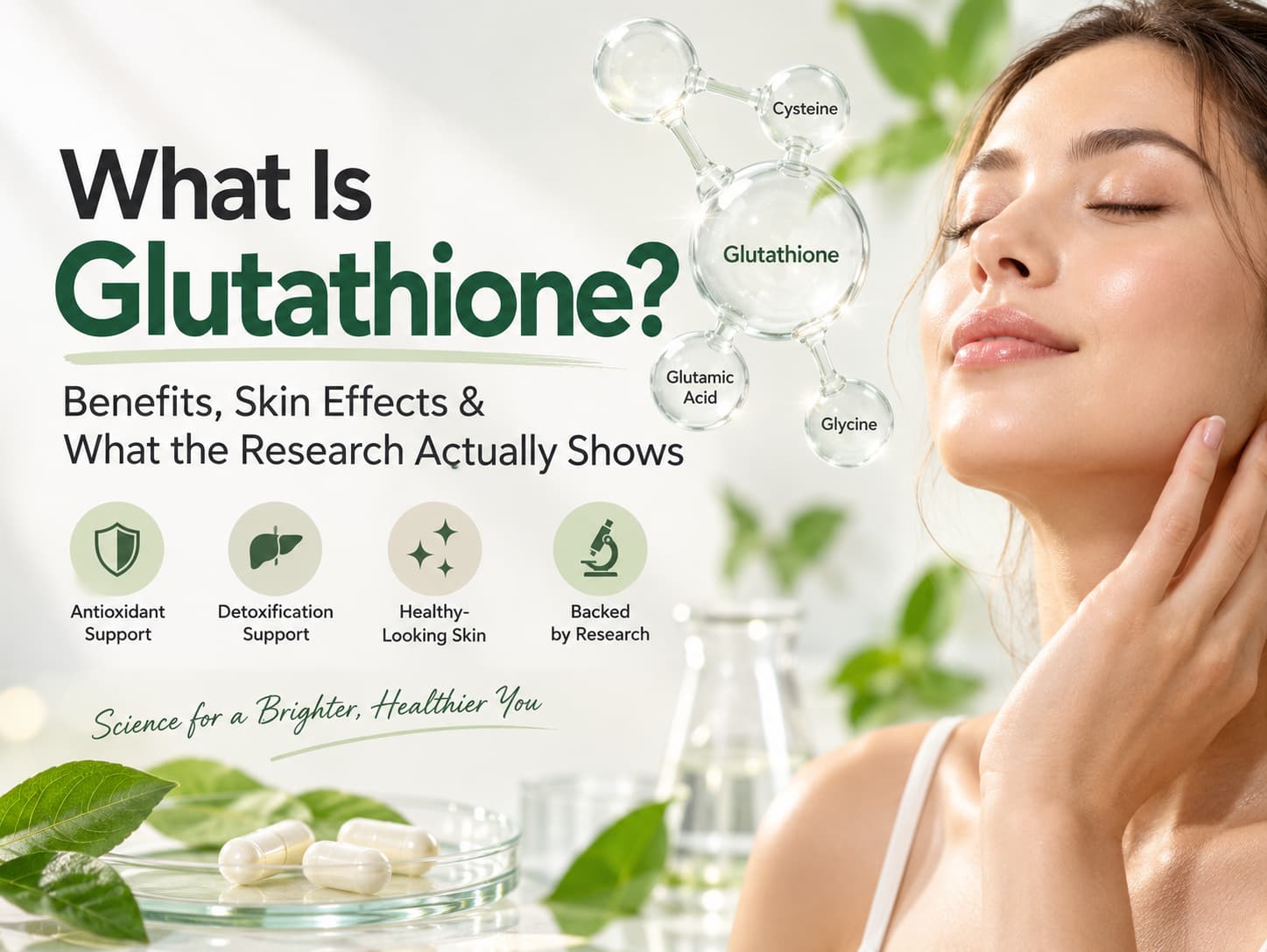
If you've been exploring antioxidant supplements or skincare ingredients, you've probably run into glutathione — often billed as one of the body's most important antioxidants. It's become a fixture in products aimed at antioxidant defense, cellular health, and healthy-looking skin. But a lot of the marketing around it outruns the science. Here is a practical, science-aware look at what glutathione actually does, what the skin research really shows, and what to check before adding it to your routine.
The short version: glutathione is a naturally occurring tripeptide your body already produces, and it plays an established role in antioxidant defense, cellular maintenance, and immune function. Some small studies suggest oral or topical glutathione may influence skin pigmentation, but results are inconsistent and it should not be treated as a guaranteed skin-whitening solution. Absorption, dose, and consistency all affect whether — and how much — a supplement does anything measurable.
What Is Glutathione?
Glutathione is a naturally occurring compound found throughout the human body — a tripeptide made from three amino acids: glutamic acid, cysteine, and glycine. Your body produces it on its own, and it's present inside many of your cells.
Its best-known role is as an antioxidant, helping protect cells from oxidative stress caused by reactive molecules known as free radicals. It also participates in enzyme reactions and helps the body process certain compounds so they can be eliminated more easily.
What Does Glutathione Do in the Body?
Glutathione isn't a one-job molecule — it participates in multiple cellular processes, particularly antioxidant protection and normal cell function.
- Helps protect cells from oxidative stress: normal metabolism, environmental exposure, UV radiation, and exercise all generate reactive molecules. When these accumulate faster than the body can manage them, oxidative stress results — and glutathione is part of the system that helps neutralize that buildup.
- Supports normal cellular health: glutathione participates in reactions involving enzymes and proteins, helping maintain the balance between oxidation and reduction inside cells — more of a built-in maintenance system than something that works in just one organ.
Potential Benefits — And What's Actually Established
Glutathione research spans a lot of ground, but it's worth separating its established biological functions from the potential benefits of taking more of it as a supplement.
1. Antioxidant Support
This is the most established role. Glutathione participates in reactions that reduce peroxides and other reactive molecules, helping the body maintain normal oxidative balance. It's more accurate to think of antioxidants as helping keep a normal biological process in balance, rather than something that "prevents" oxidation entirely.
2. Natural Detoxification Support
Glutathione is often marketed as a "detox" ingredient — a term that gets exaggerated fast. It won't remove every toxin from your body, and a supplement is not a substitute for your liver or kidneys. It does genuinely participate in some of the biochemical processes the body uses to process and eliminate certain compounds, which is a more accurate way to describe it than "detox."
3. Immune Function
The NIH Office of Dietary Supplements notes that adequate glutathione levels matter for several aspects of innate and adaptive immune activity, including normal T-cell function. That doesn't mean taking it will prevent you from getting sick — it's one of many compounds the body uses to support normal immune processes, alongside diet, activity, and sleep.
4. Skin and Complexion
This is likely the reason you've heard of glutathione in the first place. Researchers have studied whether it may influence melanin production and skin pigmentation, and some clinical trials have reported reductions in melanin measurements after oral or topical use. But study sizes have generally been small, results haven't always been consistent, and researchers continue to call for larger, longer-term studies.
Glutathione may support a brighter, more even-looking complexion in some people — it should not be treated as a guaranteed skin-whitening solution. A healthy-looking complexion is also shaped by sun exposure, genetics, skincare habits, sleep, diet, hydration, and age.
Does Glutathione Really Brighten Skin?
One randomized, placebo-controlled study of oral glutathione found significant changes in melanin measurements at some — but not all — areas evaluated, and the researchers flagged that longer-term safety needed further study. More recent reviews reach a similar conclusion: there's evidence glutathione may affect pigmentation, but the size and consistency of the effect vary, and stronger long-term research is still needed.
If you're considering glutathione mainly for skin, aim your expectations at "healthy-looking glow and antioxidant support" rather than dramatic or guaranteed changes in skin color — and keep daily sun protection as your foundation regardless.
Do Oral Glutathione Supplements Actually Work?
This is more complicated than most supplement ads suggest. Because glutathione is a peptide, it can be broken down during digestion, and scientists have long debated how efficiently conventional oral glutathione is absorbed. The NIH notes that much of the research suggests conventional oral glutathione doesn't reliably raise intracellular glutathione — one reason precursor compounds like NAC (N-acetylcysteine) have also been studied.
The evidence isn't entirely one-sided, though: in one six-month randomized, double-blind, placebo-controlled study in healthy adults, daily oral glutathione at 250 mg or 1,000 mg increased glutathione levels in several measured body compartments, with results depending on dose and duration.
The takeaway: oral glutathione's absorption and effectiveness depend on formulation, dose, duration, and individual factors that researchers are still studying — which is exactly why products promising immediate or dramatic results deserve skepticism.
What Does "Reduced Glutathione" Mean?
You'll often see the term reduced glutathione or GSH on labels. Glutathione exists in different states as part of the body's antioxidant cycle — reduced glutathione (GSH) is the active form that participates directly in antioxidant reactions, then converts to an oxidized form after reacting, and the body continually recycles it between the two. "Reduced" describes its chemical state, not a smaller dose.
How to Use Glutathione Responsibly
- Match the dose to the goal: studies on skin pigmentation have commonly used about 250–500 mg/day, while studies on body glutathione levels have gone as high as 1,000 mg/day — but a research dose isn't automatically a personal recommendation. Follow your product's label.
- Set a realistic timeline: skin-related trials have often run several weeks; body-level studies have run for months. This isn't a same-day effect.
- Check the form: look for products that clearly state reduced glutathione (GSH) content, not just "glutathione" as a vague ingredient name.
- Be consistent: absorption and effect depend partly on regular use, not occasional dosing.
- Know the difference between oral and IV: IV glutathione is sometimes promoted for cosmetic skin lightening, but reviews have raised concerns about limited evidence, non-standardized protocols, and potentially serious side effects. An IV version is not simply a "stronger" version of an oral supplement.
Talk with a healthcare professional first if you:
are pregnant or breastfeeding; take prescription medications; have an existing medical condition; are receiving cancer treatment or other specialized care; or are unsure whether glutathione is appropriate for you.
The Bigger Picture: Supporting Your Body's Own Antioxidant System
Your body already makes glutathione from amino acids — supplements are meant to supplement that process, not replace it. A few habits do more for your overall antioxidant status than any single ingredient:
- Eat a varied, protein-adequate diet: broccoli, Brussels sprouts, cauliflower, spinach, avocado, asparagus, garlic, onions, eggs, fish, and poultry all support the body's natural antioxidant and glutathione-related processes.
- Protect your skin daily: sun protection remains one of the most important habits for a healthy-looking complexion, with or without a supplement.
- Prioritize sleep and activity: both support normal immune and cellular function alongside any antioxidant support you're taking.
- Think pattern, not superfood: your overall dietary pattern matters more than any single "glutathione food."
What Does Research Say About Glutathione Supplements?
Based on glutathione's established biological roles — and assuming a clearly labeled, adequately dosed product — the most reasonable expectations are:
- support for the body's normal antioxidant defenses;
- participation in normal cellular and detoxification pathways;
- support for normal immune function;
- a possible, individually variable effect on skin brightness or evenness with consistent use.
Oral glutathione has generally been well tolerated in the relatively small clinical studies conducted so far, but long-term evidence is more limited than a lot of marketing implies. It should not be presented as treating, curing, or preventing any medical condition, and it is not a substitute for medical care.
How to Choose a Glutathione Supplement
Don't choose based on dramatic marketing claims. Look for a product that clearly states:
- Amount per serving — you should be able to easily identify how much glutathione you're getting.
- Form of glutathione — many supplements specify reduced glutathione (GSH).
- Clear ingredient labeling — avoid formulas that make it hard to tell what you're actually consuming.
- Simple directions — serving size and suggested use should be easy to follow.
- Realistic claims — be cautious of anything promising instant skin whitening, disease treatment, or guaranteed results.
Frequently Asked Questions
What is glutathione used for?
Glutathione naturally functions as an antioxidant and participates in cellular processes throughout the body. As a supplement, it's commonly used for antioxidant support, general wellness, and healthy-looking skin.
Does glutathione lighten skin?
Some small clinical trials have reported changes in melanin measurements after oral or topical glutathione use, but evidence remains limited and inconsistent — results shouldn't be considered guaranteed.
Can I take glutathione every day?
It's been taken daily in clinical studies for periods ranging from weeks to months. The appropriate product and amount vary by person — follow your label and check with a healthcare professional if you have medical concerns.
Is 1,000 mg of glutathione a lot?
Clinical research has examined oral glutathione at a range of amounts, including up to 1,000 mg/day in some studies — that doesn't mean 1,000 mg is necessary or appropriate for everyone.
A Supporting Player, Not a Miracle Ingredient
Glutathione is a naturally occurring tripeptide and a genuine part of the body's antioxidant defense system — it protects cells from oxidative stress and takes part in normal cellular, immune, and detoxification processes. It's also earned real attention for its possible role in supporting healthy-looking skin, even if the evidence there is still developing. The most useful way to think about it isn't as a miracle ingredient, but as one piece of a much larger picture that still includes a balanced diet, sleep, activity, and sun protection — with a clearly labeled formula and realistic expectations doing more for you than any bold claim on the bottle.
Sources & Further Reading
Important: this article is for general educational purposes and is not medical advice. Always follow the product label and consult a qualified healthcare professional if you have a medical condition, take medication, are pregnant or breastfeeding, or have questions about whether a supplement is right for you.
These statements have not been evaluated by the Food and Drug Administration. This product is not intended to diagnose, treat, cure, or prevent any disease.